Welcome to the Schedeasy blog, your go-to resource for all things scheduling! Here, we share expert insights, practical tips, and innovative strategies to help you streamline your scheduling processes. Whether you’re a scheduling professional, a business owner, or simply looking to organize your time more effectively, our blog covers a wide range of topics, including:
Best Practices in Scheduling: Discover proven techniques to enhance your scheduling efficiency.
Tools and Software Reviews: Stay updated on the latest scheduling tools and software to optimize your workflow.
Industry Trends: Get insights into the evolving landscape of scheduling and time management.
Case Studies: Learn from real-world examples of successful scheduling strategies implemented by others.
Join us as we explore new ideas, share success stories, and provide you with the tools you need to make scheduling easier and more effective!
Earned Value Management (EVM)
Earned Value Management (EVM) is a project management methodology that integrates cost, schedule, and scope to provide a comprehensive view of project performance. It is widely used across industries, especially in construction, aerospace, and IT, to ensure projects are delivered on time and within budget.
Key Concepts of EVM:
Planned Value (PV)
This is the budgeted cost for the work scheduled to be completed at a specific point in time.
Earned Value (EV)
Earned Value represents the actual value of the work completed so far. It helps project managers understand if the project is progressing as planned.
Actual Cost (AC)
This is the actual amount spent on the work completed by a given date.
By comparing these values, project managers can derive key performance indicators like Cost Performance Index (CPI) and Schedule Performance Index (SPI). These metrics help in predicting future performance and potential cost overruns.
Benefits of EVM:
Provides an objective measure of project progress
Identifies cost and schedule variances early
Helps forecast future project performance
EVM Formulas
- Planned Value (PV)
Formula: PV = % of planned work * Total project budget
Explanation: This is the budgeted cost of work that should have been completed by a specific point in time. - Earned Value (EV)
Formula: EV = % of actual completed work * Total project budget
Explanation: This represents the value of the work that has actually been completed so far. - Actual Cost (AC)
Formula: AC = Total cost incurred for completed work
Explanation: This is the total cost spent on the work completed by a given date. - Cost Variance (CV)
Formula: CV = EV – AC
Explanation: This shows whether the project is over or under budget. Positive CV means under budget; negative CV means over budget. - Schedule Variance (SV)
Formula: SV = EV – PV
Explanation: This measures whether a project is ahead or behind schedule. Positive SV means ahead of schedule, negative means behind. - Cost Performance Index (CPI)
Formula: CPI = EV / AC
Explanation: This index indicates how efficiently the project is using its budget. A CPI > 1 means good performance. - Schedule Performance Index (SPI)
Formula: SPI = EV / PV
Explanation: This measures schedule efficiency. SPI > 1 indicates the project is ahead of schedule. - Estimate at Completion (EAC)
Formula: EAC = Total budget / CPI
Explanation: This forecasts the total cost of the project at completion, based on current cost performance. - Estimate to Complete (ETC)
Formula: ETC = EAC – AC
Explanation: This shows the expected cost to complete the remaining project work.
How to Be More Productive During Office Hours: A Comprehensive Guide
Hello Readers, Today I am going to share an article about how to become more productive during office hours, This is very important in career success and to maintain the work life balance, if we will able to do office works in the office hours only, we will get some time for other works which is definitely for our personal and family work, this article provide you actionable time strategies to enhance your productivity and helps you to save time for your other works after office hours.
so these are as follows.
Start your day with TO-DO-LIST
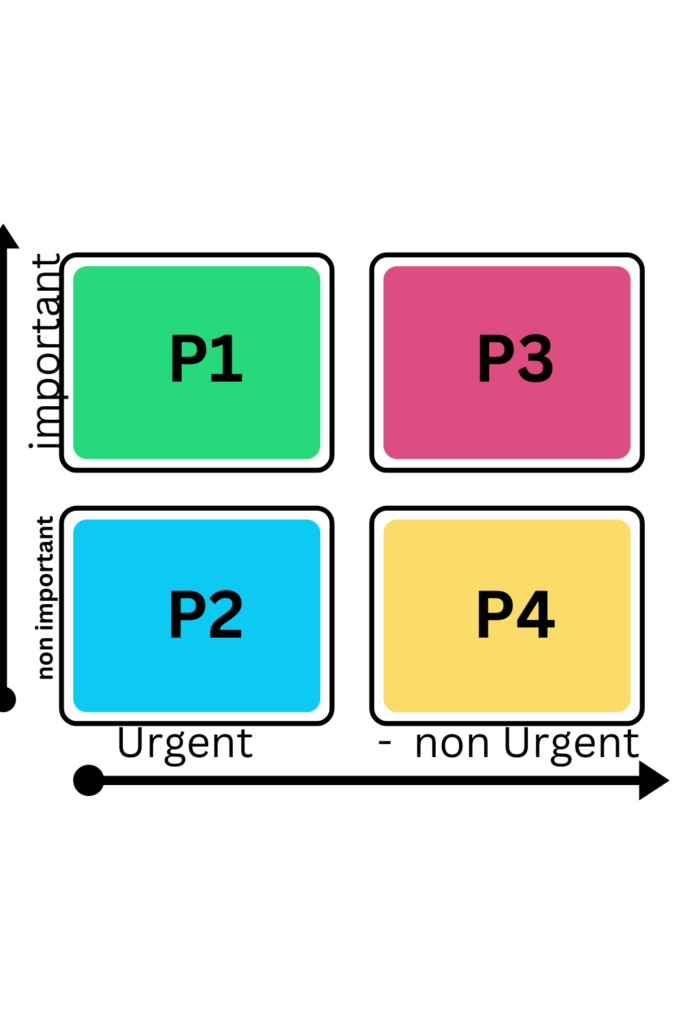
Every morning, list down your task for the day, and time estimation for each task draft, then fit this task into Eisenhower Matrix (Urgent/Important categorization.)